
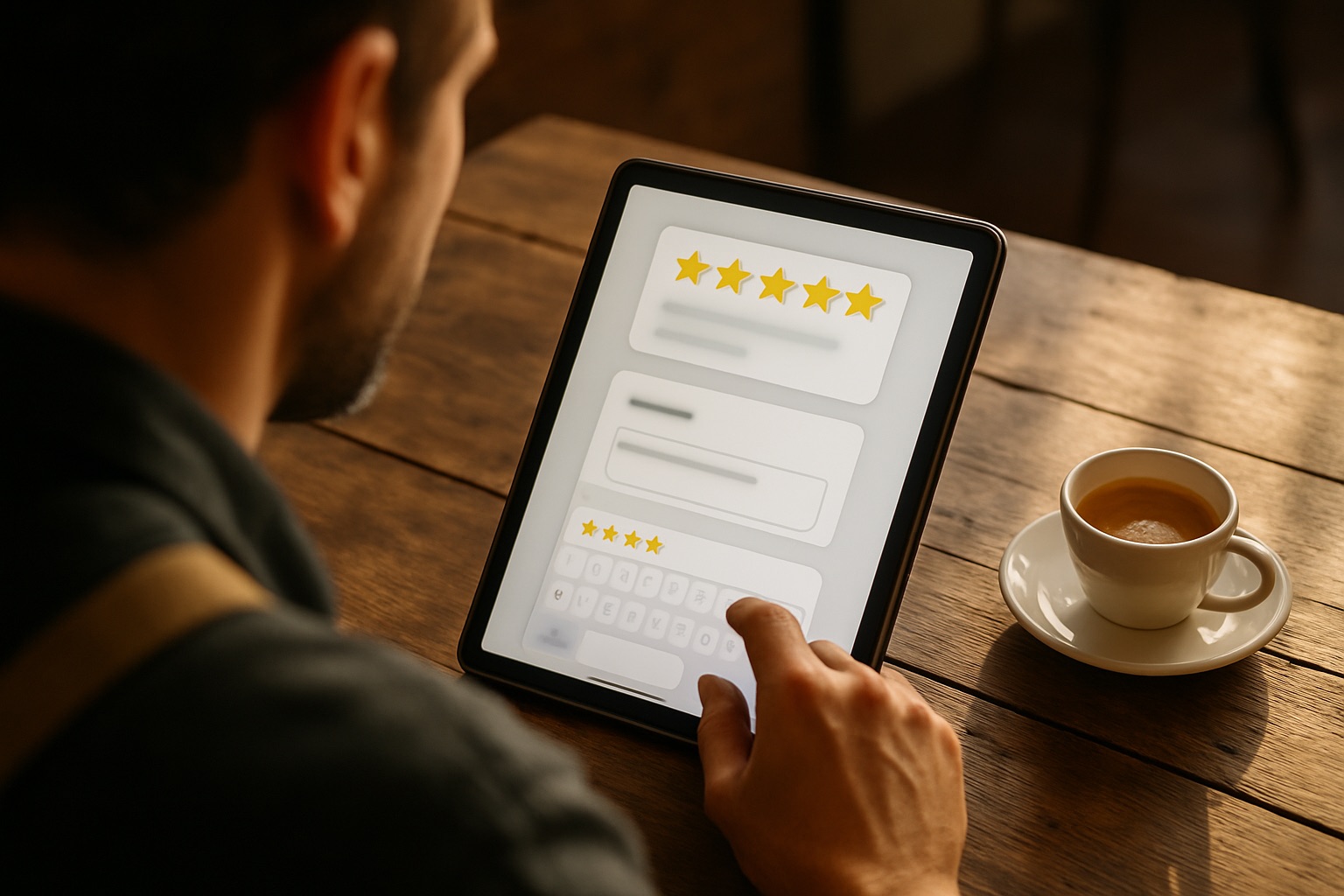
How to Respond to Google Reviews: Examples for Positive, Negative, and Fake
Here is the mental shift that changes everything about review responses: you are not writing to the reviewer. You are writing to the hundred strangers who will read that exchange over the next year while deciding whether to call you. The reviewer already made up their mind. The audience has not.
Once you see it that way, responding stops being a chore and becomes some of the highest-value marketing copy you will ever write. Google itself encourages businesses to respond to reviews, and reviews play a real role in local visibility. So let’s walk through how to respond to each kind: the glowing ones, the rough ones, and the fake ones.
Responding to Positive Reviews (Yes, It Matters)
Most businesses either ignore positive reviews or paste the same “Thanks for the kind words!” under every one. Both are wasted opportunities. A good response to a positive review does three small things: thanks them by name, echoes one specific detail from their review, and warmly invites them back.
A few examples you can adapt:
- “Thanks so much, Maria! The team was excited to hear the birthday arrangement was a hit. We would love to help with the anniversary in the fall. See you then!”
- “Thank you, James! Glad the new furnace is keeping up with this cold snap. If anything ever sounds off, you know where to find us.”
- “This made our week, thank you! Bringing your mom in for her first visit means a lot to us. We will have her usual table ready next time.”
Notice what is not in there: no keyword stuffing, no “best plumber in town” wedged in awkwardly. Write like a human, because the audience reading is deciding whether they want to deal with you, the human.
Responding to Negative Reviews Without Making It Worse
First, the disclaimer I always give: when a bad review lands, do not respond in the first hour. Feelings are not your friend here. Draft it, sit on it, then post. The framework that works:
- Thank them for the feedback. Even when it stings. It signals to readers that you take input seriously.
- Own what is genuinely yours. If you dropped the ball, say so plainly. Accountability reads as trustworthy; excuses read as a preview of what hiring you feels like.
- Correct the record gently if needed. Facts, not combat. “Our records show we offered a replacement the same day” is fine. Arguing is not.
- Take it offline. Offer a direct way to reach you and make it right.
For example: “Hi Dana, thank you for telling us about this. A forty-minute wait is not the experience we want anyone to have, and I am sorry. We have changed how we schedule Saturday appointments so this does not happen again. I would like to make it right; please call me directly at the shop and ask for Paul.”
Two cautions. Never share details about the customer’s purchase or situation beyond what they shared themselves; in fields like health care that is not just courtesy, it is the law. And never respond angry, even when they are wrong. As we covered in turning haters into fans, a gracious response to an unfair review often wins you more business than the five-star reviews do.
Handling Fake or Malicious Reviews
Sometimes a review is not from a customer at all: a competitor, someone who confused you with another business, or someone with a grudge. It feels violating, and the temptation is to go to war in the replies. Do not. Here is the calm path:
- Check your records first. Make absolutely sure this is not a real customer under a different name. Accusing a real customer of being fake is the one move worse than the fake review itself.
- Respond once, calmly, for the audience. Something like: “We take every review seriously, but we have no record of serving a customer matching this experience. If we are mistaken, please contact us directly; we would genuinely like to resolve this.”
- Report it through your Business Profile. Google has a process for flagging reviews that violate its policies. Use it, and know that removal is not guaranteed and rarely fast.
- Keep evidence. Screenshots, dates, anything relevant, in case there is a pattern worth escalating.
- Then let it go and bury it. The most reliable antidote to one fake review is a steady stream of real ones. Ten fresh five-stars make one outlier look exactly like what it is.
Make It a Habit, Not a Crisis
The businesses that do this well are not more talented writers; they just have a system. Respond to every review, ideally within a day or two. Keep a few adaptable drafts for each situation so you are never starting from a blank page. Give one person ownership of it. And pair responses with a steady ask: every happy customer, every time, because social proof is the engine of local business. One guardrail on the asking: never pay for, discount for, or otherwise reward reviews. Incentivized reviews violate Google’s policy, and that shortcut can take your whole profile down with it. Reviews were also Check #8 in why your business might not be showing up on Google Maps; the habit you build here feeds your map visibility too.
If your review section has been sitting unanswered for months and the thought of digging out feels heavy, we build review response systems for local businesses all the time. Happy to help you set one up.





I really enjoyed this perspective, especially the reminder that we’re not writing to the reviewer, we’re writing to the hundreds of people who will read the exchange later. That’s such an important mindset shift. It also made me think about trust. Every response is another opportunity to either reinforce or weaken the pattern people are building in their minds about your business. Great reminders throughout. Thanks for sharing!
Lisa, you picked up the exact point I hoped people would. Trust comes from the pattern, not from any one review. I would add one thing. Your reply to a bad review does more work than your reply to a good one. That is where people get to see how you act under pressure. Do you read the owner replies when you are picking a business?
Paul, what a beautifully written and powerfully useful post! Thank you! I will share to LI.
Kebba, thank you, and thank you for sharing it on LinkedIn. That is a good place for this one. A lot of business owners there still treat reviews as something that just happens to them. If someone asks you about the fake ones, tell them to report it first and reply second. The reply is what the next reader sees while Google takes its time.
We can learn so much from a review and even the “comments” section. I appreciate all this information you gathered together.
Lisa, you are right, and most owners never read them that way. A bad review usually names the one part of your business that keeps breaking. That is free research if you can take it without flinching. The comments under a competitor’s posts work the same way.