
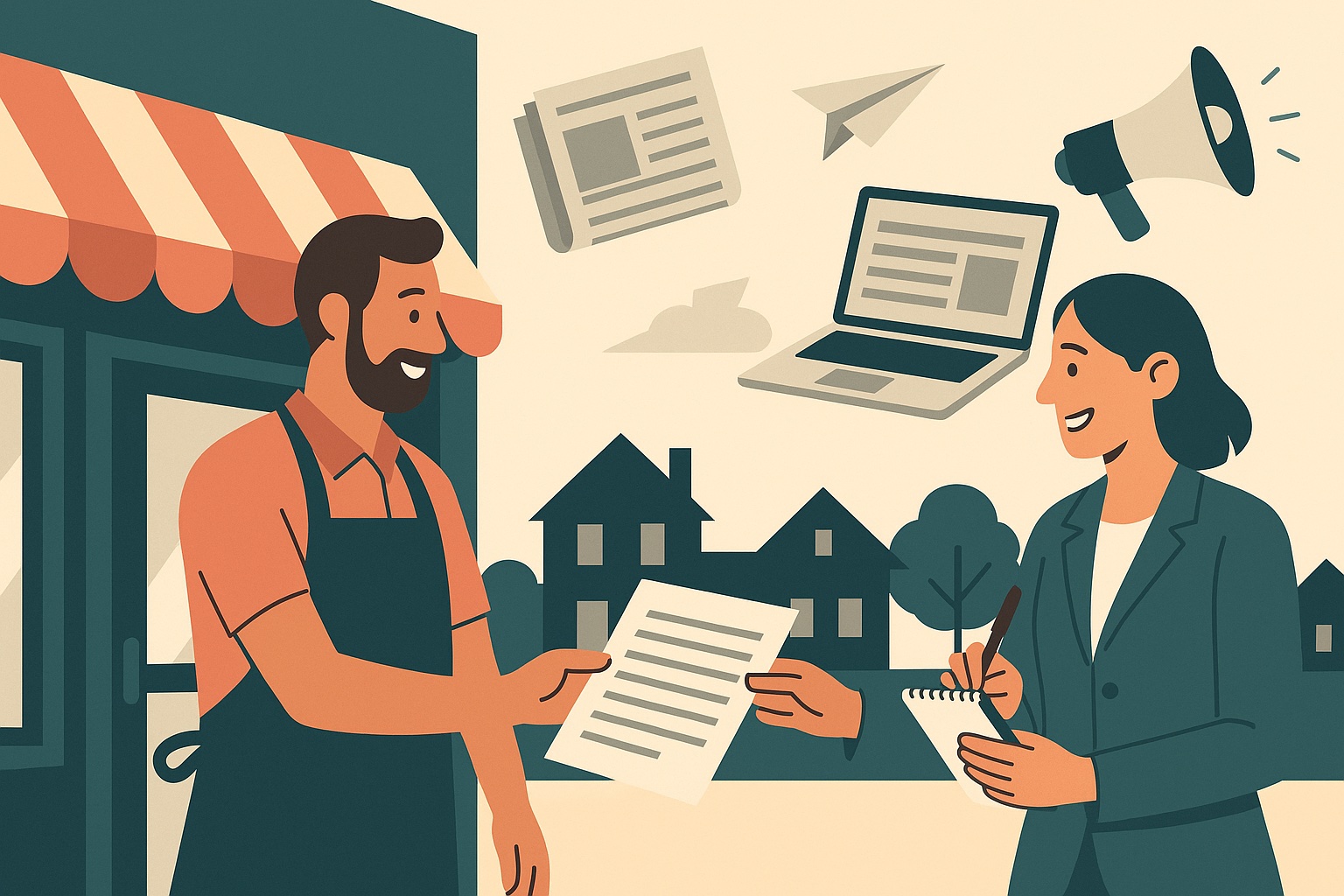
Should Your Local Business Send a Press Release? The Pros, the Cons, and Pay-to-Play Distribution
Sooner or later, someone will offer to get your business “featured on hundreds of news sites” for a fee. Before you pay, it helps to know what a press release can and can’t do for a local business. This guide covers when it makes sense to send a press release, when it’s a waste of money, what paid distribution really buys you, and how to get into your own local news without paying anything at all.
What a Press Release Actually Is
A press release is a short announcement written like a news story, meant for editors and reporters. It answers who, what, when, where, and why in the first paragraph, includes a quote from someone at the business, and ends with contact information. Its job is to make it easy for a local editor to share your news.
It is not an ad. Editors run what their readers will care about, so the release has to be about something newsworthy, not about how great your service is.
When a Press Release Is Worth Sending
A press release works when you have real news that matters to people in your town:
- Opening, moving, or adding a second location
- A milestone anniversary
- Hiring several local people or adding a new service
- Winning a local award or recognition
- Hosting a community event or a charity drive
- Partnering with a school, nonprofit, or another local business
Notice what these have in common: each one is something a neighbor might mention over dinner. Community events and charity drives are especially welcome, which is why our Giving Tuesday ideas for local businesses are a good source of news worth announcing.
When a Press Release Is a Waste
When there’s no news. “We offer quality service at fair prices” is a description, not a story, and editors will skip it.
When it’s really a sale. A discount or a promotion belongs in an ad, an email, or a social post. Sending it as a press release usually gets it ignored.
When the only goal is a boost on Google. That one deserves its own section.
Pay-to-Play Distribution: What You’re Really Buying
Paid distribution services, often called wire services, post your release to a network of sites. You get a report listing dozens or hundreds of places your release “appeared,” and often permission to put “As seen on” logos on your website.
What you usually don’t get is a reporter writing about you, or many local customers reading it. Many of those placements are automatic copies on pages few people visit.
You also don’t get a search ranking boost. Google’s spam policies specifically list “links with optimized anchor text in articles, guest posts, or press releases distributed on other sites” as link spam. Paid links are acceptable only when they are marked as paid, and links marked that way don’t pass ranking credit. Buying a release to get links back to your website is buying something Google has said it doesn’t count, and trying to game it can work against you.
Paid distribution does have a place. Public companies use wire services for announcements they are required to make, and a business launching a product nationally may want the reach. For a local business announcing local news, it is rarely the best use of the money. If a vendor is pitching you, ask three questions:
- Which specific sites will publish it, and are any of them local to my customers?
- Will an actual editor or reporter see it, or is it posted automatically?
- Can you show me how many people read releases like mine?
If the answers are vague, keep your money.
How to Get Into Your Local News for Free
Local outlets need local stories, and many of them make it easy to send yours. Here is where to look.
Patch
Patch runs a local news site for many towns. Its posting page says it “welcomes and encourages community members to post directly to the site,” and lets businesses add events to the community calendar. It also sells paid promotion, so read each option before you choose one. Many town editions also post their own “how to submit” page with the local editor’s email address.
TAPinto
TAPinto runs local news sites for many New Jersey towns. Its submission guide explains the process: click “Submit Content” on any page, choose Press Release, fill in the form, and attach photos. Staff review each submission before it goes live. You can also email a news tip to your town’s editor.
Your County Paper and Other Local Outlets
Look on your county newspaper’s website for a “Submit news” or “Community” link, or the name of the community editor. Then check the places closer to home: your chamber of commerce newsletter, your town’s website and community calendar, local radio station event listings, and neighborhood groups. A post in the right local Facebook Group can reach more neighbors than a wire service ever will.
Write It So an Editor Can Use It
- Write a plain headline that says what happened.
- Lead with the news. Put who, what, when, and where in the first two sentences.
- Add one quote from you that says why it matters to the community.
- Include a good photo and say who took it.
- Paste the release into the body of the email. Editors are busy, and many prefer not to open attachments.
- End with your name, phone number, and email so a reporter can reach you.
- Follow up once, politely, a few days later. Then let it go.
When a story runs, share it on your social media and link to it from your website. Local coverage is the kind of mention that builds trust with neighbors, and it fits naturally with becoming the go-to business in your neighborhood.
Press Release Pros and Cons at a Glance
Pros: Free when you send it to local outlets yourself. Coverage from a local news site carries more trust than an ad. It reaches people in your own town. A published story is something you can share for months.
Cons: No guarantee anyone runs it. It only works when you have real news. Paid wire distribution rarely reaches local customers, and it won’t help your Google rankings.
Frequently Asked Questions
Do press releases help SEO?
Not through the links in them. Google treats keyword-stuffed links in distributed press releases as link spam. Real coverage can still help indirectly: a local news story can bring visitors, mentions, and attention that a release on its own won’t.
Is it okay to pay a local news site to run my story?
Many local sites sell sponsored content, and that can be worthwhile if their readers are your customers. Just know it is advertising, and it should be labeled as sponsored.
Turn Your News Into Posts People See
Whether or not a newspaper runs your story, your own customers should hear about it. Digital Maestro turns your business news into social media posts and Google Business Profile updates for local businesses, so the people most likely to care actually see it.





I remember when press releases were recommended for anyone building an online business and I think I tried it a couple of times (many, many years ago). Nothing happened and eventually, I realized it wasn’t helping. But I can imagine that it would be helpful if you had genuine news.
Jeanine, a paid press release rarely helps. A short email to one local reporter often works better. Tell them your news in two or three lines. Make it about the community, not just your business.
I could see where a press release might by good when moving or opening an additional location. Sounds like a good way to get the word out to both current and potential new customers.
A move or a new location is the kind of news local papers like. Add a photo and an opening date. Update your Google profile the same day, Martha.
Great advice, Paul! Here in Switzerland, we call small and medium-sized businesses KMU (Kleine und mittlere Unternehmen). I’m not sure how interested our local press is in their activities, but I agree that a genuine community story is much more likely to catch an editor’s attention than a promotional announcement. And paying to appear on hundreds of websites that nobody reads? No thanks!
Tamara, I learned a new word today! KMU is a good one. If the local paper is not interested, try a town newsletter or a community Facebook group. Those often reach more neighbors anyway.
This sounds like a great opportunity to connect with the local community. I can see how it can be very valuable to a business if they can take advantage of it.
When a local story runs, share the link on your website and on social media, Barbara. That way the story keeps working for months, not just one day.
This is a comprehensive guide about a press release. I haven’t done one, so this PR guide is a helpful resource just in case I have a use for it. Thank you for sharing it, Paul.
A very helpful post even though I do not have a business. Everything is about content and answering the question of is it doing the job it is meant for. When I write a post, I will think of what is it I want to tell my readers. And am I sticking to the topic and story. This round of UBC, I am trying to make more meaningful comments to people’s post. It in turn does help my own writing.